
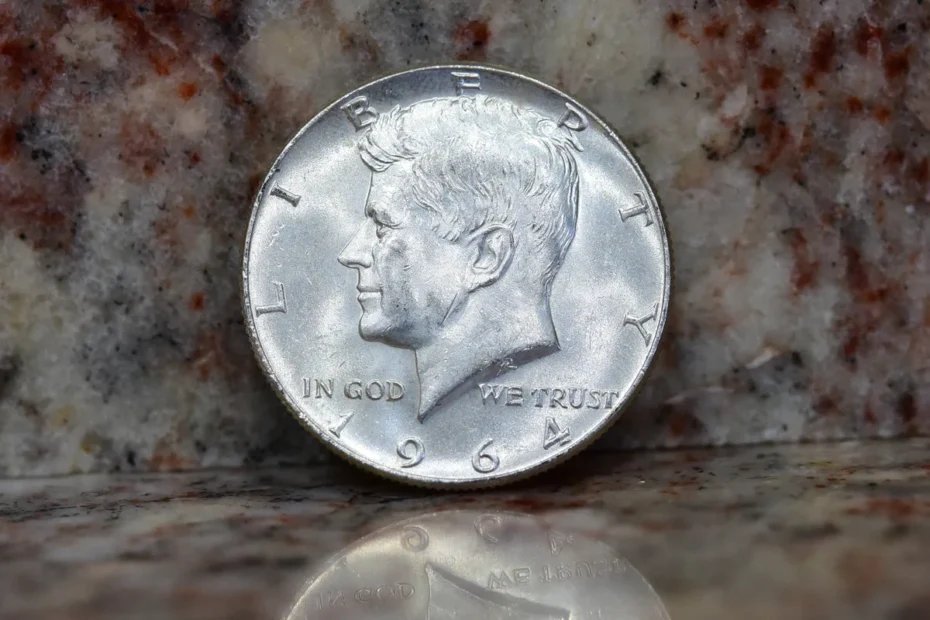
Kennedy half dollars turn up in almost every coin jar, bank bag, and estate box we see at Apex Gold Silver Coin, 605 Walnut St SW in Winston-Salem. Some are worth well over face value for their silver. Many are not silver at all. The date is the first thing to check. This FAQ answers the questions people ask us most about selling Kennedy halves: which years are silver, how we price them, what to do with rolls and sets, and how a walk-in sale works. We do not offer appraisals. We sort and test the coins on the counter and make a straight buy offer.
Quick guide to Kennedy half dollar dates
- 1964: 90% silver, about 0.36 troy oz of pure silver per coin
- 1965 to 1970: 40% silver, about 0.15 troy oz of pure silver per coin
- 1971 and later (circulation): copper-core clad, no silver, face value
- 1776-1976 Bicentennial halves from circulation: clad, no silver
- Special silver collector issues: some later proof halves from Mint silver sets are silver; we check them on the counter
For a side-by-side chart of silver dimes, quarters, halves, and dollars, see our silver coin melt-value cheat sheet.
Which Kennedy half dollars are silver?
Three groups. Kennedy halves dated 1964 are 90% silver. Halves dated 1965 through 1970 are 40% silver. Regular circulation halves dated 1971 and later, including the 1776-1976 Bicentennial halves from pocket change, are copper-core clad and have no silver. Some special Mint collector issues after 1970 were struck in silver, mostly proof coins sold in Mint silver sets.
How much silver is in a 1964 Kennedy half?
A 1964 Kennedy half dollar is 90% silver and holds about 0.36 troy ounce of pure silver. That is the same silver content as the earlier Franklin and Walking Liberty halves, so we price it the same way as other pre-1964 90% silver coins.
How much silver is in a 1965 to 1970 Kennedy half?
Kennedy halves dated 1965 through 1970 are 40% silver and hold about 0.15 troy ounce of pure silver each, a bit less than half of a 1964 half. They are worth more than face value, but less than a 1964 half, and we price them separately.
Are 1971 and later Kennedy halves worth anything?
Regular 1971 and later Kennedy halves from circulation carry no silver value. Unless one is a special silver collector issue, it is worth face value. Spend it or take it to the bank. We will gladly look over a mixed bag and pull out the silver ones for you.
Older 90% halves, quarters, and dimes are covered in our guide to selling pre-1964 silver coins.
Pricing, rolls, and collector coins
How do you price silver Kennedy halves?
We price them on silver content and that day’s silver price. Spot silver moves every day, so we do not quote a firm number without seeing the coins. This is not the same as scrap gold jewelry, which is generally paid around 75% of melt. Call ahead for a rough idea that day, then bring them in for an offer.
Do you buy rolls, bank boxes, and partial rolls?
Yes. Bring full rolls of 20, partial rolls, bags, or loose coins. You do not need to sort them first. We separate 1964, 1965 to 1970, and clad halves on the counter while you watch.
Are any Kennedy halves worth more than silver?
A few dates and varieties can carry a collector premium, but we only buy rare coins as rarities when they are already third-party graded and slabbed. Ungraded Kennedy halves are priced for their silver content. If you have a graded coin, bring it in.
Do you buy Kennedy halves in Mint sets and proof sets?
Yes. Kennedy halves often come inside US Mint proof sets, mint sets, and silver proof sets. Bring the sets as they are, still in the original packaging if you have it.
More on our graded-only policy for rarities is here: why we only buy graded rare coins. If your halves came in Mint packaging, our guide to selling US Mint proof and mint sets has more detail.
How to tell 40% silver halves from clad halves
The date is the easiest check. You can also look at the edge. A 1964 half has a solid silver-colored edge. A 1965 to 1970 half has a thin, faint stripe on the edge. A 1971 and later clad half shows a clear copper-colored stripe. On the counter we confirm with weight and non-destructive testing, so you do not need to sort or test anything at home. See how we test precious metal in the shop for what that looks like.
How selling works at the shop
- Bring it in. Walk in with your Kennedy halves and a government-issued photo ID. No appointment needed.
- We test it. We sort the coins by date and silver content and test them while you watch.
- Get paid. We explain the offer. If you accept, you get paid on the spot.
Kennedy halves often show up next to Morgan and Peace silver dollars and other old silver. Bring the whole box; we will separate it on the counter.
More quick answers
Should I clean my Kennedy halves before selling? No. Cleaning does not raise the offer and can leave scratches. Bring the coins as they are.
Do you offer appraisals? No. We do not offer appraisals. We sort and test the coins on the counter and make a straight buy offer that you can take or leave.
Do I need an appointment? No. Walk in Monday to Friday 10am to 4pm or Saturday 12pm to 3pm with the coins and a photo ID. Call (336) 505-9503 with questions.
Visit Apex Gold Silver Coin
Apex Gold Silver Coin
605 Walnut St SW, Winston-Salem, NC 27101
Phone: (336) 505-9503
Hours: Monday to Friday 10am to 4pm, Saturday 12pm to 3pm, closed Sunday
Jeff owns the shop and Tania runs it day to day. People bring Kennedy halves to us from Greensboro, High Point, Lexington, Mount Airy, and around the Triad. That is our service area; the shop itself is the one on Walnut Street in Winston-Salem.
Featured photo: 1964 Kennedy half dollar by slgckgc, via Wikimedia Commons, licensed CC BY 2.0. Cropped, resized, and converted to WebP.
